
Don't Copy Ninja: Design Patents, Mold Ownership, Exclusivity and Territory Rights in Air Fryer Ovens
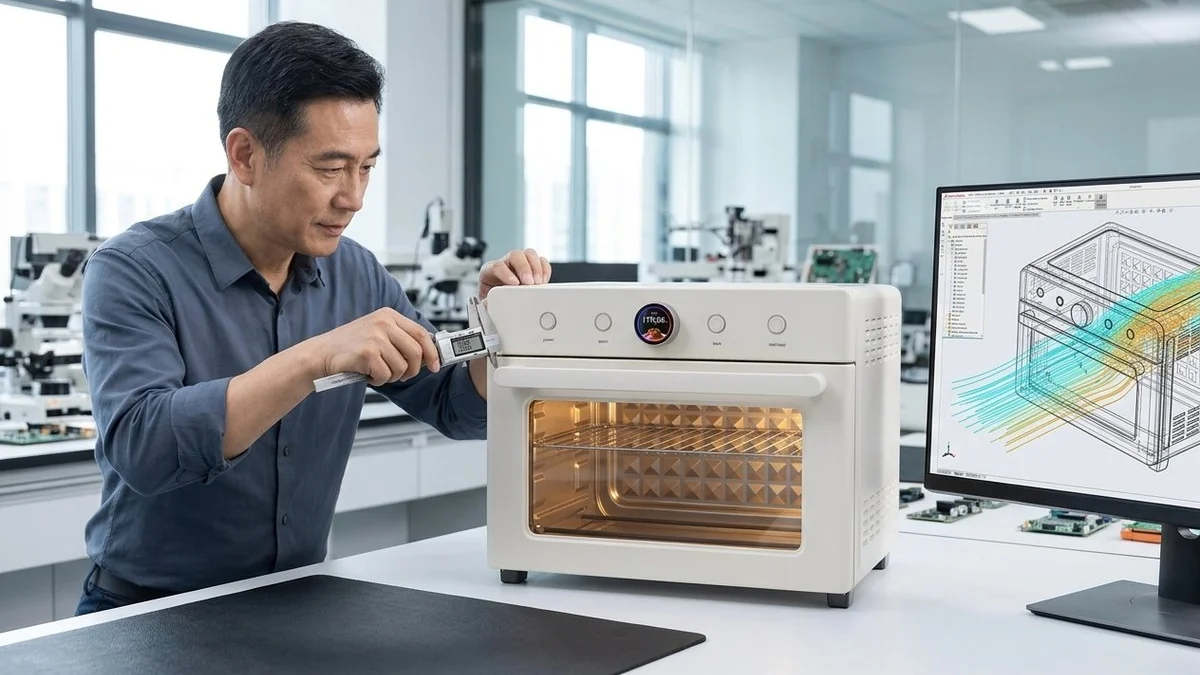
- Avoid copying patented retail silhouettes — clear industrial design checks in the US (USPTO) and EU (EUIPO) protect your brand from customs seizures and takedowns.
- For private-label builds on existing factory platforms, confirm non-infringement and regional color/UI differentiation.
- When investing in custom ODM tooling, specify mold ownership, storage, and territorial exclusivity clauses in a signed agreement.
Every season, a buyer finds a hero product they want to match: a glass-basket fryer that is selling out, a dual-basket model dominating search results, a French-door oven with a distinctive look.
The fastest route — asking a factory to copy it — is also the fastest route to a delisted listing, a seized shipment, or a lawsuit that arrives after the tooling is already paid for.
Patent and exclusivity risk is ranked among the top concerns for private-label buyers in our research, with strong evidence on the patent side from primary court filings, and a deliberate silence on the exclusivity side: no factory source retrieved in our research publishes its exclusivity terms (Source: research synthesis of court filings and factory guides).
This article explains both halves honestly, so you can protect the brand asset you are paying to build.
1. Live Cases: This Is Not a Theoretical Risk
On 8 May 2026, SharkNinja filed suit in the District of Massachusetts (case 1:26-cv-12116) against Nanjing Pukou Xisheng, alleging that the USHALO 4-in-1 Glass Air Fryer infringes Ninja's CRISPi design patent D1,100,567 and utility patent 12,426,739 (Source: SharkNinja v. Nanjing Pukou Xisheng, Complaint 1:26-cv-12116, D. Mass., filed 8 May 2026).
Read that carefully: the product at issue is a glass air fryer — exactly the format many buyers now want to launch to ride the PFAS-free, glass-basket trend. The trend is real, but the specific glass-container shape, handle geometry, and overall appearance of the market leader are protected, and the owner is actively enforcing them.
It is not an isolated case. In SharkNinja v. RJ Brands (D.N.J., case 1:24-cv-08984), SharkNinja alleges that dual-basket and grill products infringe six patents (Source: SharkNinja v. RJ Brands, Amended Complaint 1:24-cv-08984). The same filing context notes SharkNinja states it holds 4,500+ patents in force (Source:). Two lessons follow for buyers.
First, enforcement targets importers and sellers, not only factories — your company name is on the listing and the import record.
Second, the two most-copied formats in this category, glass crispers and dual baskets, are precisely the formats with live litigation around them. "The factory offered it to everyone" is not a defence; it is how multiple sellers end up infringing the same patent at the same time.
2. Design Patents vs Utility Patents: The Basics Buyers Actually Need
Buyers do not need a law degree, but they do need to separate two different kinds of protection, because a product can clear one and infringe the other.
Design patents protect how a product looks — its ornamental appearance. US design patent D1,100,567 in the CRISPi case is an example (Source:). Copying the shape, proportions, and visible details of a protected design can infringe even if your product cooks differently inside.
Utility patents protect how a product works — a mechanism, airflow path, heating arrangement, or control method. Utility patent 12,426,739 is cited alongside the design patent in the CRISPi complaint, and six patents are alleged in the dual-basket case (Sources:).
Trademarks and trade dress protect names, logos, and distinctive overall presentation. Using a competitor's model name in your listing title or packaging is a separate, avoidable risk.
Copyright can apply to manuals, photos, and listing images. Copying a brand's manual text or A+ images is infringement even when the product itself is clean.
The practical consequence: a freedom-to-operate check must look at appearance and mechanism, in each market you will sell in, because patent rights are territorial. A design that is unprotected in one country may be registered and enforced in the United States or the EU.
3. A Pre-Launch Patent-Check Workflow You Can Actually Run
Do this before you pay for tooling, not after the container ships.
Step 1 — Fix the design. Freeze drawings, photos, and a physical sample of the exact product, including accessories and packaging appearance. A check on a "similar" product protects nothing.
Step 2 — Search the registers. Search design and utility filings by the brand owners active in this category (Ninja/SharkNinja, Breville, Philips and others) in your target markets, plus image-based design searching where the register supports it.
Step 3 — Get a written opinion. For any hero SKU, commission a patent attorney or qualified search firm in the destination market to give a written freedom-to-operate view. Keep the report — it is evidence of good faith and your insurer or platform may ask for it.
Step 4 — Change, license, or walk away. If a conflict appears, redesign the visible features that create the conflict, seek a licence, or drop the SKU. Redesigning a handle, control layout, or basket geometry before tooling costs a drawing change; after tooling it costs a mold.
Step 5 — Re-check at listing. Repeat a light check when the final production sample and listing images are ready, because late design changes can reintroduce the problem.
How this works in practice at Linden: before we launch a model such as our 12L oven, the KA1203, a design and utility patent search for the intended sales markets is part of the launch process, and we can commission the same search for a private-label program — the markets covered and the search scope are agreed per project, the cost is confirmed by quotation, and the written report is supplied as part of the program documentation.
Ask us — or any factory — what their search process covers before you commit to tooling.
4. Mold Ownership: The Contract Language That Decides Everything Later
The mold question and the patent question meet in one sentence of your contract. industry supplier benchmarks, "competitors can purchase the same base product"; with ODM, buyers should "negotiate mold ownership explicitly". In other words, if you do not negotiate it, you do not have it.
Your agreement should state, in writing: who paid for the tooling and who owns it; whether the factory may use the mold for any other customer, in any market, ever; what happens to the mold if you move production (release, transfer, and who pays freight); how mold maintenance, repair, and end-of-life replacement are charged; and whether drawings, BOM, and firmware files are deliverables you own or merely use.
Custom mold investment is significant — industry benchmarks gives supplier ranges of $20,000–50,000 plus 30–45 days in one guide, and a wider $15,000–80,000 and 60–120 days for full ODM in another — flagged here as supplier ranges, not a quotation. At that level of spend, an unsigned assumption about ownership is an unforced error.
For comparison, the standard terms at Linden start from the principle this article keeps returning to: whoever pays for the tooling owns the mold. Once the tooling invoice is paid in full, the mold belongs to the buyer, and a customer-owned mold is never used for any other customer, in any market.
The tooling lead time, the mold storage and routine maintenance terms, and the release procedure if you move production — including the release timeline and who bears the freight — are set out in the mold agreement before tooling starts. Whatever factory you choose, get terms like these — yours, not a blog's — written into the contract.
5. How Territory and Channel Exclusivity Is Actually Structured
Here is the honest part most factory blogs avoid: no factory publishes its exclusivity terms. In our research, one factory, Yaoyuan, explicitly states in its brief that it "does not guarantee… market exclusivity". That silence is itself the lesson — exclusivity is negotiated case by case, never a standard listing feature, and any blog or salesperson promising it casually should be asked to put it in the contract.
When exclusivity is granted, it is normally structured along four dimensions, and you should negotiate each one explicitly:
| Dimension | What to define |
|---|---|
| Territory | Named countries/regions — not "overseas" or "Europe" in general |
| Channel | Retail, e-commerce, Amazon-only, TV shopping, etc. — a factory may grant one channel and keep others |
| Scope | The exact model/design covered, including whether color or accessory variants count as the same product |
| Conditions | Minimum annual volume, duration, renewal, and what happens to exclusivity if the volume is missed |
Get the remedy in writing too: what happens if the same design appears in your territory through another buyer — production stop, compensation, or termination rights. An exclusivity clause without a remedy and a volume condition is marketing, not protection.
At Linden, exclusivity is structured in the agreement itself, item by item: the model covered, the named territory, the channels included, the duration, and the minimum annual volume the exclusivity is conditional on are each written into the exclusivity agreement — as are the consequence if the volume is missed (for example, conversion to non-exclusive supply rather than cancellation) and the remedy if the same design appears in the territory through another buyer.
And the starting position stays as stated in our OEM terms: brand ownership alone does not create exclusivity — unless exclusivity is separately negotiated, the underlying platform may be supplied to other customers. Use the table above as the checklist of points to pin down — with your factory's real terms, in the contract.
6. If a Platform Flags Your Listing: The First 72 Hours
For Amazon and marketplace sellers, the first sign of trouble is usually a platform IP complaint, not a court letter. Work this sequence: stop and preserve — do not delete evidence; screenshot the complaint, the listing, and your design files. Identify the right cited (design, utility, or trademark) and the registration number.
Compare your production sample — not your render — against the cited right with your supplier and, for anything non-trivial, a local IP attorney. Respond within the platform deadline with your freedom-to-operate report, mold-ownership documents, and any redesign evidence; silence usually means the listing stays down.
In parallel, decide the commercial path: redesign, licence, or exit the SKU, and quantify tooling and inventory exposure before you negotiate. Finally, feed the lesson back into Step 3 of the workflow above for every future hero product.
If you sourced the product from Linden, send the complaint notice to [email protected] and we will supply the mold-ownership documents and design files for the affected model as an urgent response, so your platform response is not waiting on your supplier.
Buyer FAQ
The factory says "everyone sells this design." Does that protect me? No. The live cases above were brought against sellers/importers of widely offered designs (Sources:). Wide availability can mean wide infringement.
Can a factory guarantee I will not be sued? No factory can guarantee a court's decision. Treat any such promise as a red flag; ask instead for their patent-check process and mold/design ownership documents.
Is exclusivity standard if I pay for the mold? No. Payment, ownership, and exclusivity are three separate points, and exclusivity terms are not published by factories (Sources:). Contract each one.
Do I need a check for every market? Yes — patent rights are territorial, and enforcement activity cited here is US-based (Sources:). Check where you will import and sell.
Talk to Us About a Design You Can Own
If you are planning a private-label oven, send us the design direction you have in mind before you commit to tooling, and we will walk through the patent-check, mold-ownership, and exclusivity questions in this article with you, in writing. Contact Linden at [email protected] or +86 156 2237 7841 — we reply to IP and mold-ownership enquiries within 8 business hours, and with your RFQ we can share our patent-search process note, a sample mold-ownership clause and a sample exclusivity clause.
Ready to Spec Your OEM/ODM Air Fryer Oven Line?
Get factory FOB pricing, test certificates, and 500–1,000 unit MOQ customization options within 24 hours.
Related Sourcing Guides
Which Air Fryer Oven Should You Launch? Capacity & Feature Tiers Mapped to Channel (E-commerce, Retail, Premium)
"Which model should we launch?" is the wrong first question. The right question is: which capacity and feature tier fits my channel, my shelf price, and...
From RFQ to Container: Lead Times, Peak-Season Planning, Payment Terms and Inspection — The Complete Order Timeline
Most first-order disasters are not product failures. They are timeline failures: an RFQ so vague that three factories quote three different products...