
Retail-Ready and FBA-Ready Packaging: Color Box, ISTA Drop Testing, Carton and Pallet Specs
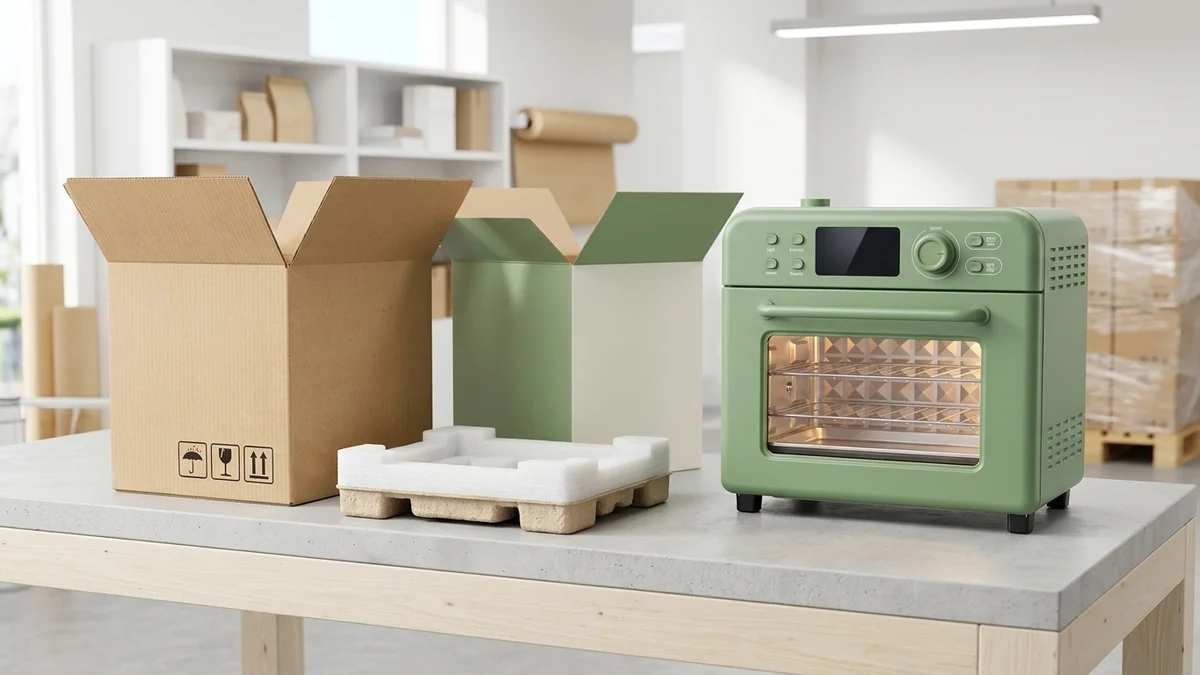
- Retail brick-and-mortar and Amazon FBA require different packaging engineering — FBA parcel shipping demands ISTA-3A drop-tested double-wall cartons.
- Precision-molded EPE foam or reinforced pulp corner inserts protect glass doors and control dials during multi-touch parcel transit.
- Confirm giftbox finish, barcode placement, warning labels, and palletization specs before approving pre-production packaging proofs.
For a retail buyer, packaging is not a finishing touch — it is a pass/fail gate. A countertop air fryer oven can pass every electrical test and still be rejected at the distribution center because the color box scuffs, the barcode does not scan, or the master carton fails in transit.
For an Amazon seller, the same failure looks different but costs the same: an FBA inbound refusal, a damaged-unit return, or a one-star review that mentions a shattered glass door.
Packaging is checklist item #7 in the independent sourcing checklists buyer checklist for air fryer manufacturers, and it appears in every factory OEM menu reviewed in our research — yet the specifics of drop testing and FBA readiness are covered mainly by inspection-industry sources, not factory blogs.
This guide closes that gap: what "retail-ready and FBA-ready" actually means, section by section, before you sign off a packaging spec.
1. Color-Box Construction and Print Proofing
The color (gift) box does three jobs at once: it protects the product, it sells the product on a shelf or a product page, and it carries the compliance and barcode information the channel requires. Construction decisions therefore start with board grade and internal protection, not with artwork.
An oven-style unit with a glass door needs molded pulp, EPE foam, or a structured cardboard insert that immobilises the door and the accessories — loose packing that works for a basket fryer will not survive an oven's weight distribution.
Print proofing is where experienced buyers slow down. Approve a physical proof, not a PDF: colors shift on kraft and coated board, and fine print — capacity claims, wattage, certification marks, warning labels — must be legible at final size.
Check that every market-specific element matches the version being packed: plug type shown, voltage, language set, and the exact model number that appears on the rating label and the certificate.
Our standard process at Linden: digital and physical color-box proofing costs are agreed per project; a physical proof is produced to the schedule agreed at artwork sign-off, and the agreed proofing cost is credited against your first mass order.
2. Drop-Test and ISTA Options — and What "Pass" Means
"Drop tested" is meaningless without the procedure name. The ISTA 1-series procedures are the basic packaged-product integrity tests used across the industry; ISTA-6 procedures cover retailer and marketplace ship-in-own-container programs (Cloudspects FBA inbound checklist, which also notes that Amazon's published FBA rules govern labeling, weight and dimensions rather than mandating a drop test for ordinary cartons).
Separately, many factories run an in-house 80 cm drop test as part of QC — useful as a line check, but it is not a substitute for a named ISTA report when a retailer asks for one.
When you discuss testing with any factory, pin down four things in writing:
Procedure — which ISTA procedure, or which internal standard, was applied
Specimen — the exact retail pack, with product, accessories and inserts, not an empty carton
Sequence — number of drops, orientations (corner, edges, faces) and drop height for the packaged weight
Pass criteria — no functional damage, no glass breakage, no deformation that affects use, and cosmetic limits agreed in advance
For our AE3009 (30L), the current retail pack is tested to ISTA 1A — the procedure named in the model's product specification — and the test report is held in the model's packaging file, available for buyer review; ISTA testing for other models or revised packs is arranged to your retail channel's requirements. In production, every packaging revision is also checked against our in-house drop procedure on corner, edge and face orientations before it is released.
3. Master-Carton and 40HQ Loading Maths
Carton maths decides your landed cost per unit as surely as FOB price does. Buyers ask for the master-carton dimensions, gross weight, units per carton, and loading quantities per 20GP, 40GP and 40HQ — then they check the arithmetic themselves.
As a reference point for the format of this data, one factory listing in our research (Qiaokang, supplier-stated) quotes its 14L rotisserie oven at 360 / 720 / 1,008 pieces per 20GP / 40GP / 40HQ. Your numbers will differ by model and carton design; what matters is that they are measured from the final pack, not estimated from a prototype carton.
Two traps recur. First, a late packaging change — a thicker insert added after a drop-test failure — can push the carton over a container or courier threshold and quietly erase the margin you negotiated. Second, palletised retail programs add their own constraints: pallet height, carton orientation and labeling position. Freeze the packaging spec before the final quotation, and re-quote freight if the spec changes.
Our current production figures are below — carton dimensions and weights are confirmed on the final packing specification for your order, and the AE3009 ships with foam protection inside a 5-layer master carton:
| Model | Color-box size | Master-carton size | Units per carton | Gross weight | 20GP / 40GP / 40HQ |
|---|---|---|---|---|---|
| KA1203 (12L) | Per final pack spec | Per final pack spec | 1 pc | Per final pack spec | 570 / 1,220 / 1,420 pcs |
| AE3009 (30L) | Per final pack spec | 480 × 423 × 390 mm | 1 pc | 10.5 kg | 330 / 670 / 790 pcs |
4. Barcode, UPC and FNSKU Workflow
Barcode errors are the cheapest mistake to prevent and one of the most expensive to fix after printing. Assign responsibilities explicitly: who supplies the UPC/EAN (normally the brand owner, from their GS1 account), who generates the artwork, and who verifies the printed code with a scanner or verifier before mass printing.
For Amazon programs, decide whether FNSKU labels are applied at the factory, and confirm label size, placement and the carton-level labels FBA inbound requires (Cloudspects FBA inbound checklist). Keep a one-page barcode sign-off sheet in the order file: code number, symbology, size, quiet zones, placement photo, and the name of the person who scanned the production sample.
Manual and barcode accuracy is not bureaucratic detail — Walmart's production-testing protocol literally tests manual typos, QR codes and customer-service numbers (Lifeworks supplier summary of the Walmart CTL protocol, 2026).
5. FBA Limits: Weight, Polybag Warnings and Inbound Rules
For Amazon sellers, design the pack to Amazon's published rules from the start. The buyer's standard question, as recorded in our research, is whether the pack is FBA-ready — including labels, polybag warnings and cartons at or under 50 lb.
If accessories or parts ship in polybags, the suffocation-warning requirement applies; if the unit is heavy, confirm the carton weight against the current limit rather than a remembered one, because marketplace rules change and the current published rule governs.
Also plan for how the pack performs as its own shipper: an oven that travels in only its retail box needs the protection level of a shipping carton, which is exactly what ISTA-6-type programs are designed to test. At Linden, FBA labeling, polybag warning printing and carton repacking are available as value-added services, with pricing confirmed by quotation in writing before production starts.
6. Packaging Sign-Off Checklist
Use this checklist before you release print or confirm mass production:
Color-box physical proof approved, with market version, plug and voltage artwork checked
Certification marks and warning labels match the exact model and destination market
Drop-test procedure, specimen and pass criteria documented; report on file
Master-carton dimensions, gross weight and container loading measured from the final pack
UPC/EAN verified by scan; FNSKU and carton labels assigned and placed per channel rules
Polybag suffocation warnings and any Prop 65 or recycling marks confirmed for the destination
Pallet spec (if any) confirmed: height, orientation, label position
Packaging freeze date recorded; any later change triggers a freight re-quote
Buyer FAQ
Do I need ISTA testing for every order? No — you need it when the pack design changes, when a retailer program requires a report, or when damage rates tell you the current pack is failing. An unchanged, proven pack does not need re-testing on every repeat order.
Can the factory print my UPC and apply FNSKU labels? Most OEM factories will; the risk is not capability but verification. Keep the scan-verification step in your sign-off regardless of who prints.
What is the single most common packaging failure? In this category, transit damage to glass doors and accessories that were not immobilised — followed by barcode and label mismatches discovered at inbound.
Work With Us on Packaging That Passes Inbound
Send us your channel requirements — retail, FBA, or both — and the market version you are launching, and we will respond with a packaging specification, a drop-test plan and carton loading figures for your model. Contact Linden at [email protected] or +86 156 2237 7841 — we reply within 8 business hours.
Ready to Spec Your OEM/ODM Air Fryer Oven Line?
Get factory FOB pricing, test certificates, and 500–1,000 unit MOQ customization options within 24 hours.
Related Sourcing Guides

Warranty, Spare Parts and After-Sales for Private-Label Air Fryer Ovens: What a Serious Factory Commits To
A retail buyer does not list a private-label air fryer oven because the first container sells. They list it because they believe the second year will not...
Passing Retailer Audits: BSCI, SMETA, ISO 9001 and Production Testing — A Factory Readiness Guide
For a retail buyer, the audit file is not due diligence theatre — it is the listing decision. Product, price and packaging can all be right, and the...