
What the Cosori and Insignia Recalls Teach B2B Buyers: 7 Safety Questions to Ask Any Air Fryer Factory

- Major appliance recalls trace back to preventable hardware failures: undersized wire crimps, missing thermal cutoffs, and excessive housing heat.
- Audit seven non-negotiables before ordering: model-specific safety listings, dual thermal protection, flame-retardant wiring, door-switch interlocks, and 100% hipot logs.
- Establish a documented lot-traceability and spare-parts escalation protocol with your factory prior to first shipment.
The Two Recalls Every Buyer Should Know
Cosori — CPSC recall 23-130, 23 Feb 2023. Around 2 million air fryers were recalled in the United States, plus roughly 250,000 in Canada and 21,000 in Mexico. The cause was a wire connection that could overheat, posing fire and burn hazards. The CPSC record lists 205 reports of the fryers catching fire, burning, melting, overheating or smoking, including 10 reports of minor burn injuries and 23 reports of minor property damage (CPSC recall 23-130, Feb 2023).
Insignia — March 2024. Around 187,400 Insignia air fryers and air fryer ovens were recalled, with overheating as the central issue — including handles melting or breaking and door glass shattering (recall summaries, Mar 2024).
Neither brand set out to ship a dangerous product. Both recalls happened at scale, in the most scrutinised retail market in the world, to products that had passed through normal commercial channels. That is the lesson: recall risk is not a "cheap factory" problem. It is a design-detail, production-control and traceability problem — and as the importer or brand owner, the liability lands on you.
To make this concrete, here is how one factory answers for itself: at Foshan Linden Intelligent Appliances Co., Ltd. (Linden), the main wire connection on the KA1203 is a positive-locking crimp connector, every unit is traceable by serial number to its production batch, and our recall-response contact is the quality team at [email protected], with a first response within 8 business hours. Hold every factory — including us — to this level of specificity.
Lesson 1: Failure Modes Are Specific — So Your Questions Must Be
Recalls in this category cluster around a short list of failure modes: electrical connectors and wiring overheating; handles and door components failing under heat; glass doors shattering; and control or thermostat faults letting temperatures run away. The Which? reliability survey shows the everyday version of the same story: among faulty units, cooking performance deteriorating (24%), control panels stopping working (19%) and trays breaking (14%) are the top faults (Which?, 2025/2026). The seven questions below convert those failure modes into an RFQ checklist.
The 7 Safety Questions
Question 1: How is the main wire connection made — and how is it verified on the line?
The Cosori failure was a wire connection overheating (CPSC recall 23-130). Ask how connections are made (crimp, weld, connector type), how seating is verified during assembly, and whether the verification is visual only or a pull/electrical test. Then ask to see it on the line, not in a slide deck.
Question 2: What are your 100% end-of-line electrical tests?
Every unit — not a sample — should pass hipot/dielectric, leakage-current and earth-continuity testing. Published OEM benchmarks are hipot at 1,500–3,000V for 1 minute, leakage below 0.5 mA, and thermostat accuracy within ±5°C. Ask for today's line records.
Question 3: What heat testing do handles, doors and glass pass?
Insignia's recall involved melting/breaking handles and shattering door glass (Mar 2024). Ask for the material specification of every part near the cavity, its temperature rating, and the abnormal-operation test results — for example, what happens to the door and handle if the thermostat fails and the element stays on.
Question 4: Can you trace this unit to its batch, line and component lots?
If a defect is found in the field, can the factory identify exactly which production lots used the suspect component — or does the whole shipment (or your whole program) become suspect? Batch traceability, with component lot records retained, is what turns a potential total recall into a bounded corrective action.
Question 5: Is the certificate for this exact model — and is production identical to the certified sample?
Certification must list the exact model number you will buy. The follow-up question matters just as much: what change control prevents production units from drifting away from the certified construction — a cheaper connector, a different thermostat — after approval?
Question 6: Are you ready for retailer production testing?
Large retailers do not rely on your certificate alone. Walmart's production-testing program takes roughly 10 weeks from application to report, with reports valid for one year (Lifeworks Supplier Portal summary, 2026; Walmart Responsible Sourcing guidance, updated Sep 2024). Ask whether the factory has been through the target retailer's testing before, on which models, and what failed and was fixed.
Question 7: What happens, in writing, if something goes wrong in the field?
Ask for the recall-response and warranty process before you need it: who is the contact, how are field reports logged and escalated, how fast are replacement parts and corrected units supplied, and how are costs shared? The market norm buyers plan around is a 1-year warranty with 1–2% free-of-charge spare parts in the container — your agreement should be at least that explicit.
Design Safeguards Worth Demanding
Connector and wiring designs with positive locking and strain relief, verified in assembly
Independent over-temperature protection (thermal fuse / cut-out) separate from the control thermostat
Heat-rated materials specified — and locked in the BOM — for handles, door frames and inner panels
Door glass specification with thermal-shock testing, not just thickness
Change control: no component substitution on safety parts without written buyer approval and, where needed, re-testing
On the KA1203, Linden uses an independent thermal fuse as over-temperature protection, separate from the control thermostat, a positive-locking connector with strain relief, and tempered door glass specified and thermal-shock tested as part of the model's safety file. Any safety-part substitution requires the buyer's written approval before production — that change-control rule is part of our order terms.
Batch Traceability: The Cheapest Insurance You Will Ever Buy
Traceability sounds like paperwork until the day it saves a program. A workable system links each finished unit's serial or batch code to: production date and line, component lots for safety parts (element, thermostat, motor, control board, connector), the line test records for that batch, and the inspection reports for that shipment. When a field report arrives, that chain lets you isolate affected lots in hours. Without it, every unit you have ever shipped is in scope.
At Linden, each KA1203 carries a serial code that links to the production line, the production date and the component lots for the safety parts — element, thermostat, motor and control board. Traceability records are retained under our document-retention schedule, and a de-identified sample traceability file is available to buyers on request, so you can inspect the chain before the day you need it.
What a Factory's Answers Should Look Like
Good answers are specific, dated and documentary: test values, report numbers, named materials, a change-control clause. Bad answers are adjectives: "high quality", "strict QC", "export standard". If a factory cannot answer Question 1 and Question 2 with documents, the remaining five answers do not matter — walk away, whatever the price. And apply the same standard to us: we would rather lose an order on a document we cannot produce than win one on a promise we cannot keep.
For the KA1203, the documents behind our answers are held in the model's technical file: the batch line-test records, the certificate and test reports for your market route, and the abnormal-operation test evidence. Request the file index from our quality team at [email protected], and we will supply the documents that apply to your version.
Buyer FAQ
Does passing ETL/CE testing eliminate recall risk? No. Certification validates a sample and a construction; recalls like Cosori's arise from production execution and component behavior at scale (CPSC recall 23-130). That is why line tests, change control and traceability matter as much as the certificate.
Should I pay for my own pre-shipment inspection? Experienced buyers do — third-party PSI through agencies such as SGS, Intertek, Bureau Veritas or TÜV, sampled to AQL 2.5 major / 4.0 minor (ISO 2859-1), is standard practice in this category.
Who carries recall liability? In the US and EU, the importer/brand placing the product on the market carries primary regulatory responsibility — which is why these questions belong in your RFQ, not in a post-incident email.
Put These Questions in Your Next RFQ
Copy the seven questions into your RFQ to any factory — including us. If you send them to us, we will answer each one with the document or test record behind it, and flag honestly anything that is in progress rather than in place.
Contact Linden at [email protected] or +86 156 2237 7841.
Ready to Spec Your OEM/ODM Air Fryer Oven Line?
Get factory FOB pricing, test certificates, and 500–1,000 unit MOQ customization options within 24 hours.
Related Sourcing Guides
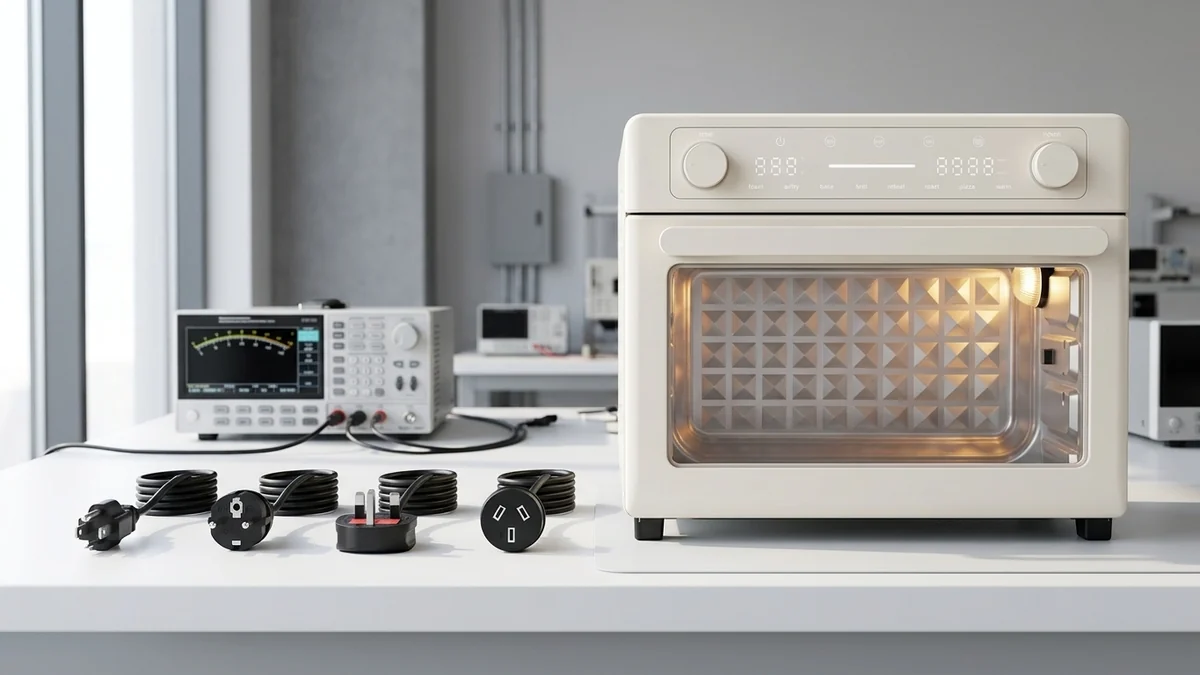
120V vs 220–240V: Building US, EU, UK and AU Versions of the Same Air Fryer Oven
An air fryer oven is not one product with four plugs. It is one platform that has to be re-engineered, re-certified and re-documented for each electrical...
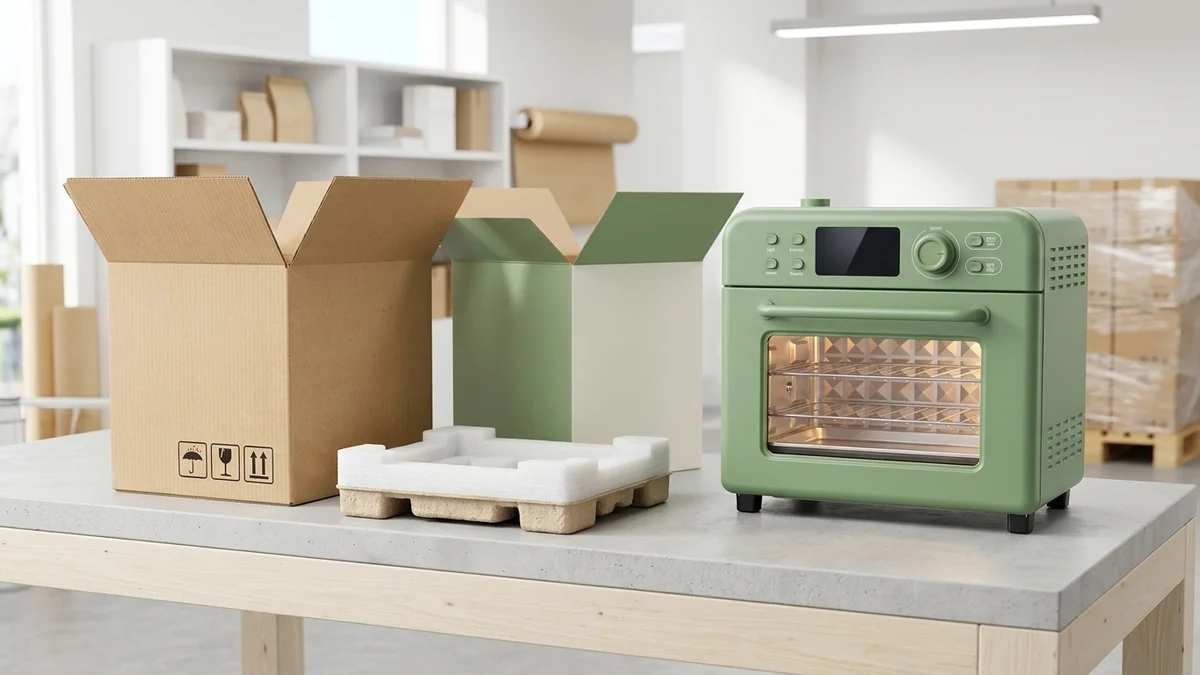
Retail-Ready and FBA-Ready Packaging: Color Box, ISTA Drop Testing, Carton and Pallet Specs
For a retail buyer, packaging is not a finishing touch — it is a pass/fail gate. A countertop air fryer oven can pass every electrical test and still be...