
Air Fryer Oven vs. Air Fryer vs. Convection Oven
Contents
- Basket air fryers win on compact footprint and single-portion speed, while countertop air fryer ovens win on multi-rack versatility and family-size capacity.
- Compared with traditional convection toaster ovens, air fryer ovens deliver faster preheat, higher fan velocity, and crisper oil-free browning.
- Most successful kitchen brands carry a hero 16L or 30L air fryer oven as their mid-to-premium tier above entry basket fryers.
What's the Difference — and Which One Should Your Brand Sell?
Consumers use these three names interchangeably. They shouldn't. Picking the wrong form factor for the wrong household costs you more than a sale — it costs you a return, a one-star "too small" review, and a warehouse full of the wrong SKU. This guide breaks down what each appliance actually does, which countertop it belongs on, and how to build a lineup that covers real demand without launching three overlapping products.
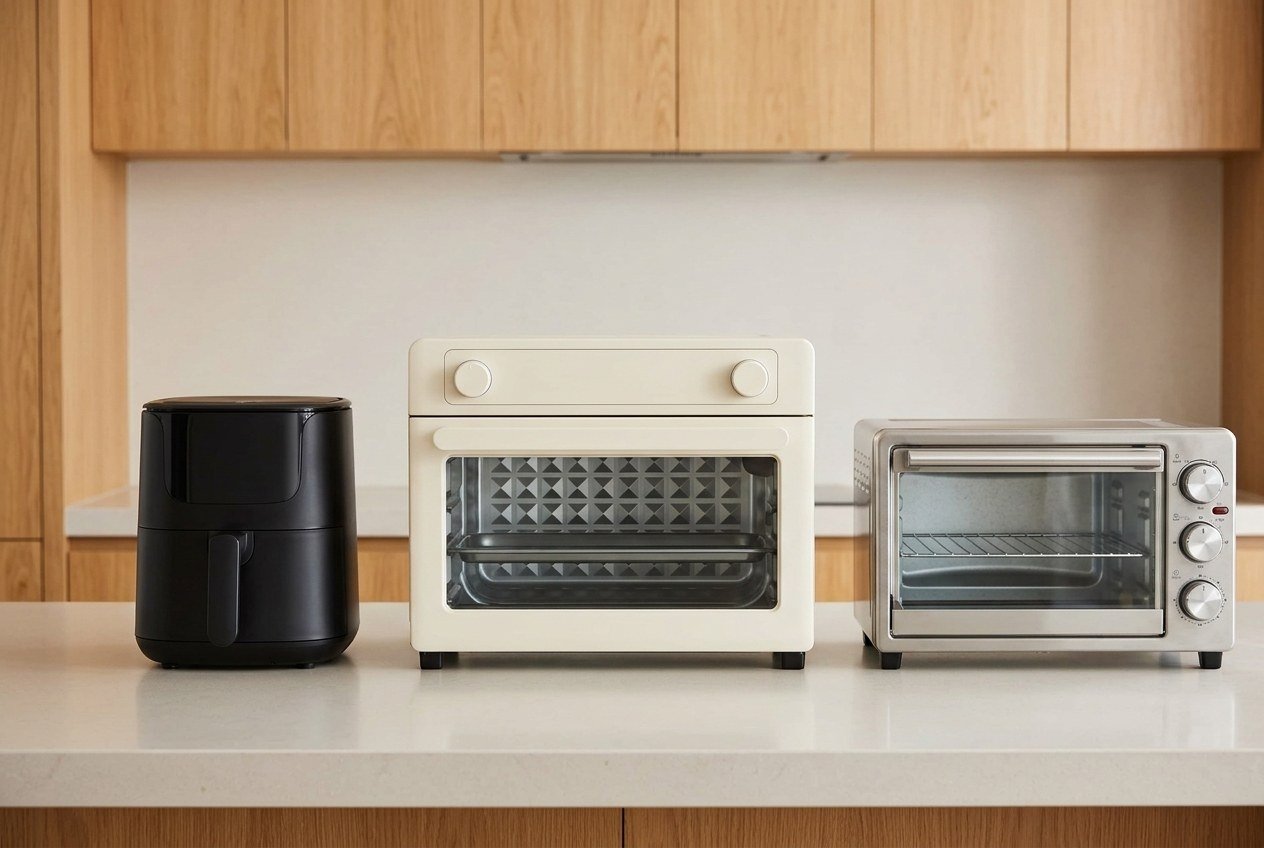
The One-Minute Version:A basket air fryer is the fastest way to crisp small batches. An air fryer oven is the everyday household workhorse — larger, multi-rack, and built to roast, bake, toast, and dehydrate in one unit. A convection oven is a full-size oven with a fan: the most uniform choice for large-scale baking, but not a countertop shortcut. Most appliance brands need the first two. Very few gain anything by blurring them together.
They All Cook with Hot Air — and That's Where the Similarity Ends
All three appliances cook food by circulating hot air. The difference lies in how fast the air moves, how large the cavity is, and how the food is positioned — three factors that shape the result far more than any preset button.
A basket air fryer pairs a compact cavity with a high-speed fan mounted directly above a perforated basket. Hot air hits a small batch of food hard and fast. That is why fries and wings crisp up quickly — and why the same machine struggles as soon as it is overfilled or asked to cook two layers at once.
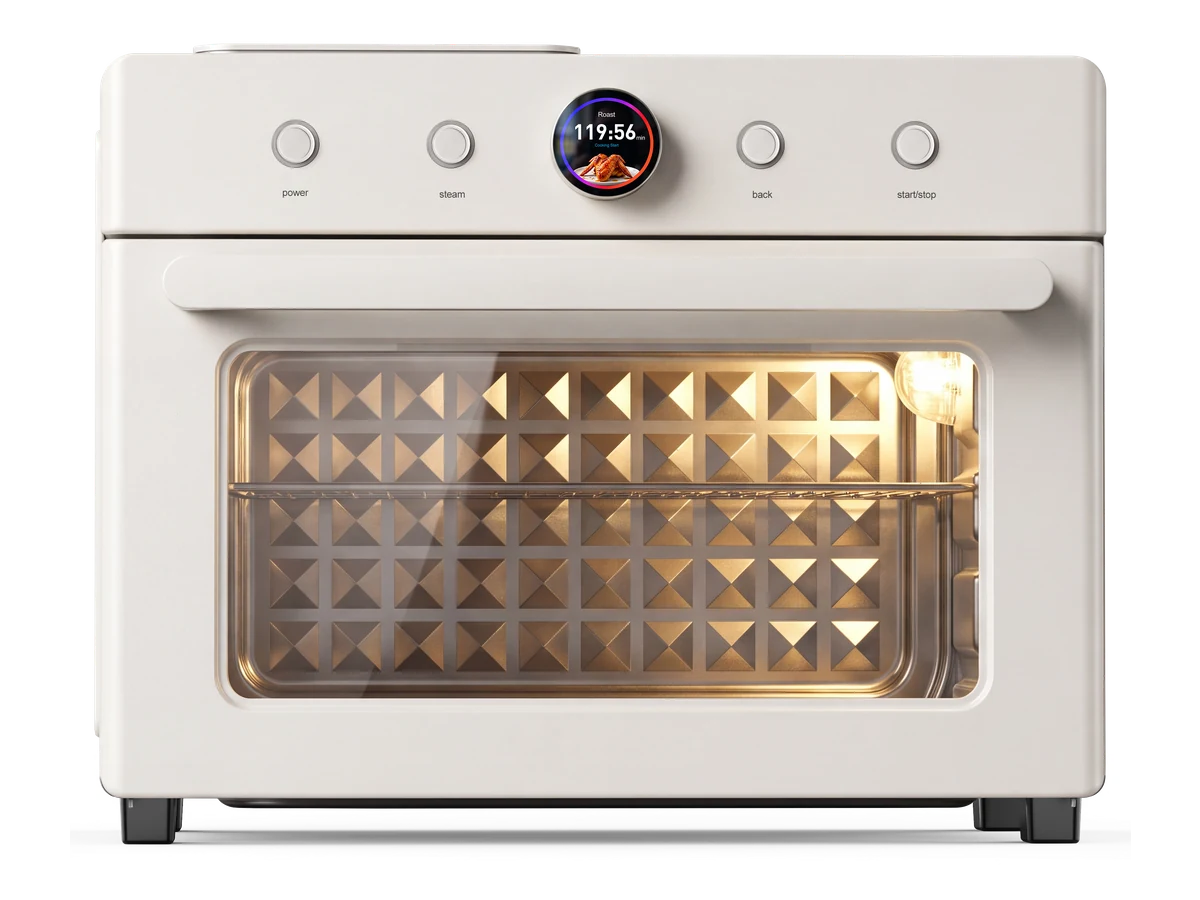
An air fryer oven keeps the high-output fan and intense heat, but houses them in a rectangular, oven-style cavity with wire racks, a baking pan, and a viewing door. Food spreads out in a single flat layer or cooks across two to three rack levels at once, fitting a whole pizza or a whole chicken while unlocking functions a pull-out basket struggles to deliver — toasting, baking, rotisserie roasting, and dehydrating included.
A convection oven is an oven first. In built-in or full-size ranges, the fan's job is to keep temperatures even across a large cavity rather than blasting a small basket. It can air fry — especially when paired with an air fry tray — but it has a much larger space to preheat and wasn't designed to race through a small batch of fries.
Countertop convection ovens sit in the middle, and many modern countertop models have quietly evolved into air fryer ovens with stronger airflow and air fry presets — which is right where the naming confusion begins.
Side-by-Side Comparison
Use this table to position each appliance type within your lineup. The "Air Fryer Oven" column below uses actual LINDEN models — the 16L AE1606 and the 30L AE3009. The basket air fryer and full-size convection oven columns show typical market figures, not LINDEN models: LINDEN's current lineup does not include basket air fryers. Always verify actual internal cavity dimensions before listing any product.
| Basket Air Fryer | Air Fryer Oven | Convection Oven | |
|---|---|---|---|
| Typical Capacity | 2–6 qt (typical market range, not a LINDEN model) | AE1606:16L;AE3009:30L | Full-size cavity (general); countertop models approx. 17–25L |
| Best For | Fries, wings, reheating for 1–3 people | Families, whole chickens, pizzas, multi-rack cooking — AE3009 fits a 352 × 300 mm rack | Baking, full-size sheet pans, and holiday-scale cooking |
| Rack Levels | 1 Fry Basket | 3 rack levels (AE3009); 2–3 racks/pans | 2+ full-size rack levels |
| Common Add-On Features | Fewer presets, with shake reminder | AE3009: Toast, Air Fry, Bake, Broil, Reheat, Roast, Pizza, Keep Warm; AE3007 features 9 presets plus 7 steam-assisted modes | Bake, broil, roast; newer models include air fry |
| Factory Area | Smallest | Medium — AE3009 measures 428 × 406 × 334 mm; requires clearance on top and sides for heat dissipation | Built-in, or large countertop footprint |
| Preheating & Speed | Fastest for Small Batches | Fast; slightly slower than a basket model for a small handful of fries | Slowest — largest cavity to heat |
| Typical US retail price tier | Entry-Level to Mid-Range | Mid-range to premium; AE3009 features 120V/60Hz dual voltage for the US market | Mid-range to premium (higher for built-in units) |
| Top Complaint | "Too small" / overcrowded | Tray and cavity cleaning; learning rack positions | Preheating takes too long for small portions |
One more note on capacity numbers: a quart inside a tall, narrow basket is not the same workspace as a quart spread across a wide rack. Consumers don't cook in liters. They cook a whole chicken, a frozen pizza, or enough fries for four people without running a second batch. Specify the food that fits, not just the volume.
Capacity Is Where Consumers Most Often Buy Wrong
Most returns in this category aren't defects — they're wrong sizing. Someone shopping for dinner for five buys a compact basket fryer because the liter number sounds big enough, then spends the first night cooking in three batches.
Think in meals, not measurements:
- Singles & couples:For one or two people making snacks or reheating leftovers, a 2- to 4-quart basket unit is honestly plenty, and it stays out on the counter instead of sitting in a cabinet — which means it actually gets used.
- Households of three to five:Step up to an air fryer oven. The wide cavity fits a 12-inch pizza, a tray of vegetables alongside a tray of chicken, or a whole chicken on the rotisserie spit — without piling food on top of itself. The AE3009 wire rack measures 352 × 300 mm — measure your pizza against the rack, not the liter rating.
- Serious bakers and large households:Start with workspace. A full-size convection oven still wins for sheet-pan baking and holiday feasts. An air fryer oven handles everyday cooking faster without heating up the whole kitchen.
If you are writing a product listing, do your buyers a favor: show the interior width, show the rack positions, and photograph real food inside — a whole chicken, a pizza, a baking pan. A single line saying "30L" tells a first-time buyer almost nothing, and one factory's "30L" cavity doesn't always match another's.
What Each Format Actually Does Best
Crisping: for small batches, basket models still have an edge
Concentrated airflow in a compact chamber crisps food fast. For a single layer of fries, nuggets, or wings, a basket unit is hard to beat, and shaking a basket mid-cook is simpler than rotating trays. The trade-off is scale: pack the basket full and the crunch disappears — air can't circulate around the food, so you end up steaming instead of frying.
Versatility: Where the Air Fryer Oven Pulls Ahead
Toast in the morning, a tray of salmon at lunch, a roast chicken for dinner, and fruit dehydrating overnight — that is the case for the oven form factor, and it is a strong one. Racks, trays, and a glass door make it behave like the oven your customers already know, only smaller and faster.
Rotisserie and dehydration are not gimmicks on the right model; they are the two features buyers mention most when explaining why they chose an oven over a basket. They are also the two features to test hardest during sampling, because a wobbly spit, hard-to-clean forks, or an overflowing drip tray will show up in reviews within a week.
The seven steam-assisted modes on the AE3007 (Juicy Chicken, Tender Fish, Steamed Shrimp, Juicy Beef, Bread Refresh, Gentle Veg, and Gentle Reheat) make it the steam option in the LINDEN lineup, while the AE3009 ships with a rotisserie spit set.
Baking: The Full-Size Convection Oven Remains the Benchmark
For cakes, two full sheets of cookies, or anything sensitive to hot spots, the even, gentle circulation of a traditional convection oven remains the safest bet. An air fryer oven can bake very well — many households use it as their primary oven — but its stronger fan can brown tops earlier, so recipes often need a slight temperature adjustment. A good manual says so upfront. A bad one pretends no adjustment is needed, and customer reviews do the correcting.
Speed, Energy Use & Everyday Usability Details
Yes — a compact cavity preheats faster and typically uses less electricity for a small meal than heating a full-size wall oven. No — that does not mean the lowest wattage wins. What households feel every day is total time to the table: preheating, plus batch count, plus cleanup.
An air fryer oven that takes four minutes longer for one full load still beats a basket model that needs two batches. A fast machine that's painful to clean — baked-on grease around the fan, a tray that won't fit the sink, a door that traps crumbs — ends up shoved to the back of a cabinet.
When evaluating samples, run the greasy test, not just the easy one: cook skin-on chicken followed by frozen fries, then wash the entire unit yourself from start to finish. Time the cleanup. Your customers will.
Noise and exterior heat are part of the same physics. A high-airflow fan makes audible noise, and a countertop oven releases warmth into a compact kitchen. Neither is a dealbreaker on its own, but both belong in honest product copy. Brands that set clear expectations up front see far fewer surprises in customer reviews.
Which One Should Your Brand or Store Carry?
Don't start with a factory catalog. Start with the households you sell to and the retail price point you need to hit.
- If your customers are price-sensitive and short on counter space,Put a solid basket model at your entry price point without apologizing for its size — position it honestly for what it is: fast and built for small batches. Apartments, dorms, RVs, and first-time buyers are a real market, not a compromise market.
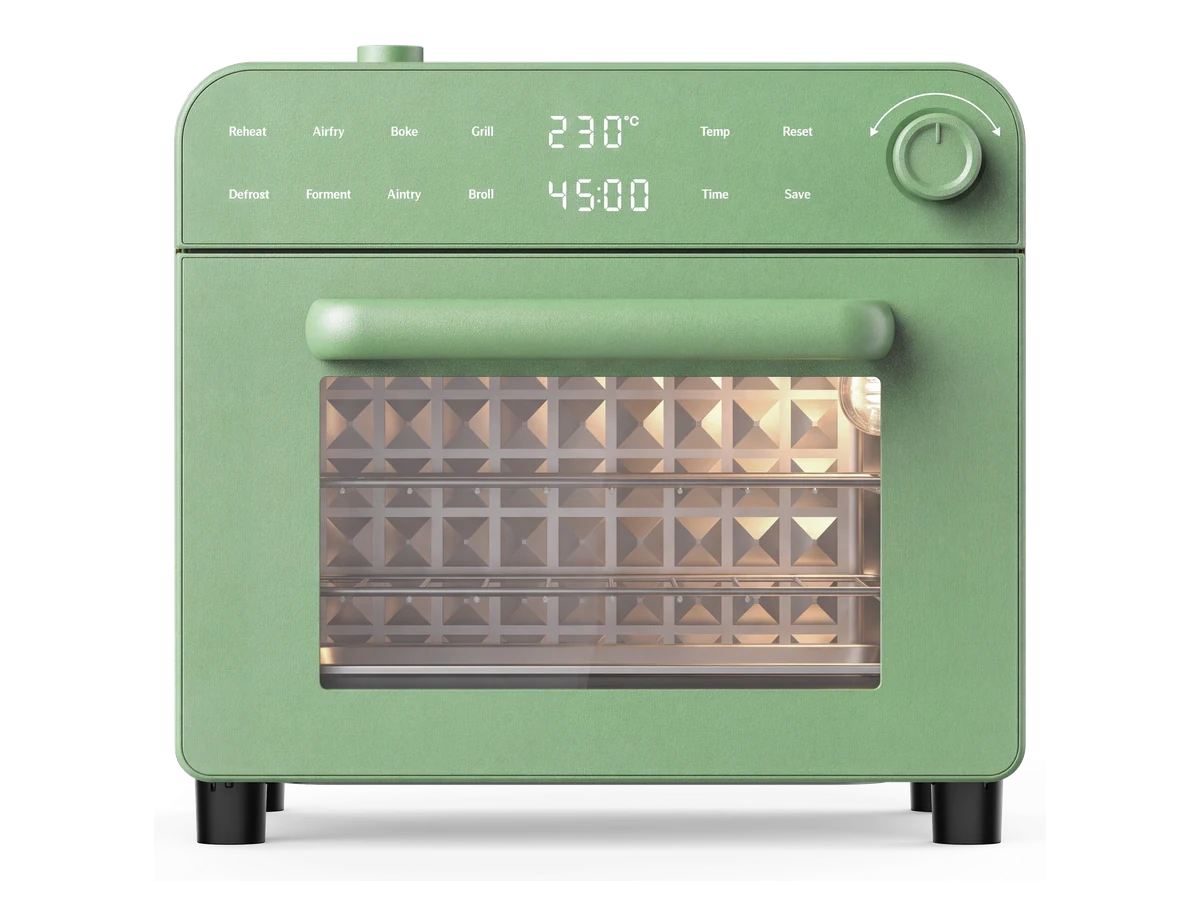
- If your customers cook family dinners,Lead with the air fryer oven. It replaces other appliances instead of adding another gadget to the counter, supports a higher average selling price, and gives you real room to differentiate — door style, cavity material, control interface, and included accessories all show up clearly in product photos and daily use.
- If you have room for two countertop models in your lineup,If you carry both, make the step-up obvious: an entry-level basket fryer and a step-up countertop oven. What rarely works is offering two ovens that differ by one liter, share the same door and presets, and sit at two price points nobody can explain. Shoppers hesitate — and hesitant shoppers don't buy.
French-door models are trending in the US right now for practical reasons beyond styling: you can open both doors with one hand while holding a tray in the other, and the doors don't swing down into the counter space in front of the oven. A single pull-down door remains more cost-effective and easier to seal reliably.
LINDEN's AE3007 and AE3009 use pull-down doors, not French doors. Neither style is automatically better — but if you choose French doors, test the seal and door alignment rigorously. A premium door that leaks heat or hangs crooked looks cheap faster than a solidly built standard door.
Cavity material is another decision consumers are beginning to ask about by name. Interest in PFAS-free, stainless steel, ceramic-coated, and glass-forward designs has risen sharply, driven by buyers who want fewer worries about coatings. You don't have to rebuild your entire lineup around it, but you do need straightforward answers to three questions: what is inside the oven, what are the trays made of, and how should they be cleaned. Just saying "non-stick" is no longer a complete answer.
Private-Label Sourcing Essentials
The comparisons above matter even more when your brand name is printed on the box — because every cut corner becomes your 1-star review, your return rate, and your support ticket.
- Start with voltage and certifications.Ask for a native build for your target market, not a converted one. For the US, that means a true 120V design — the AE3009 runs on 120V/60Hz as well as 220–240V — plus the certifications your channel requires, typically UL or ETL listing alongside applicable FCC and food-contact compliance. For Europe, it means CE marking with relevant EN standards, RoHS, and food-contact rules such as Germany's LFGB. LINDEN's company certification portfolio covers CE, CB, ETL, FDA, LFGB, and ROHS; verify documentation by model: CB/CE/ETL for AE3009, CE for AE3007, and confirmed by model and voltage for AE1606. Before discussing artwork, get the certificate numbers and the exact model codes they cover.
- Evaluate samples with real food, not just a wattmeter.Two ovens with the same nominal capacity can have completely different rack widths, clearances, and usable height below the top heating elements. Measure the sample, cook in it, and put the usable dimensions on your product page.
- Controls and build quality are what sell the second hundred units.You can feel whether a knob turns solidly, see whether a glass door sits flush, and notice a digital display that washes out under bright kitchen lighting every single morning. None of these show up on a spec sheet, and all of them show up in customer reviews.
- Accessories and manuals are part of the product.A sturdy baking pan, a functional crumb tray, a rotisserie spit that actually cleans up easily, and a manual that honestly explains temperature adjustment — getting these right at the sample stage is far cheaper than fixing them after mass production.
FAQ
Is an air fryer oven the same thing as a convection oven?
Not quite. Both use a fan, but an air fryer oven is a countertop appliance with faster, more concentrated airflow inside a compact cavity built for crisping as well as baking. A convection oven is a full-size oven whose fan is primarily designed for even temperature distribution. Many newer convection ovens include an air fry setting, and many air fryer ovens bake very well — the overlap is real — but their size, speed, and everyday use remain different.
Can an air fryer oven replace a regular oven?
For everyday cooking in many households, yes — especially 1-to-4-portion meals, roasting, reheating, and weeknight baking. A full-size wall or range oven still earns its place for oversized sheet pans, multi-course holiday spreads, or very large poultry. Most households end up using the countertop oven every day and firing up the full-size oven only when they need the extra space.
What size air fryer oven do I need?
Work backward from the food. If a 12-inch pizza or a whole chicken is on your regular menu, look at mid-to-large ovens — the 16L AE1606 and 30L AE3009 — and verify cavity width and whole-chicken clearance on the product page rather than relying on liter ratings alone. If you mainly reheat and crisp food for one or two people, a smaller oven or basket unit will do the job and take up less counter space.
Does an air fryer oven use less electricity than a full-size oven?
For small-to-medium meals, usually yes — because it heats a much smaller cavity and finishes cooking faster. That advantage narrows if you have to run multiple back-to-back batches for a crowd. The honest comparison is energy consumed per finished meal, not the wattage printed on the box.
Which One Is Easier to Clean?
Basket models are the simplest — one basket, one drawer. Air fryer ovens take a bit more work: racks, trays, and cavity walls. Models with a removable crumb tray, a smooth stainless steel interior, and dishwasher-safe accessories close most of the gap. Regardless of form factor, grease buildup around the heating elements and fan is what you should inspect during sampling.
Which Format Should a Brand Private-Label First?
The one that matches your channel. If you compete on price in mass retail, a basket unit is the simpler first SKU. If you sell on features, bundles, and margin — online, in specialty retail, or through your own stores — an air fryer oven gives you a much stronger product story to tell.
If you sell into the US, the AE3009's dual-voltage design makes it the straightforward first choice. Starting with the form factor your customers are already asking for beats starting with whatever model a factory happens to be pushing this month.
Bottom Line
None of the three is "best" in the abstract. A basket air fryer is the best small-batch quick crisper. An air fryer oven is the best all-around countertop cooker for families. A convection oven is the best full-size baker. Trouble starts when a product page, a lineup, or a sourcing brief pretends one appliance can be all three at once.
Define the household and define the meals, and the form factor chooses itself. Then verify the unglamorous details — usable cavity dimensions, door and controls, interior materials, certifications for your market, and how long it takes to clean after cooking a real meal. Get those right, and presets barely matter.
Next Step — Evaluating air fryer ovens for your own brand? Send us the capacity, door style, and target market you sell into, and ask for usable cavity dimensions, certification files for that exact model, and a working sample you can actually cook in — not just power on. Those three answers tell you more than any catalog page. LINDEN: [email protected], www.foslinden.com.
You May Also Be Interested In

How Does an Air Fryer Oven Work? A Buying Guide
Heating elements, fan speed and cavity design — the factors that actually decide cooking results, explained for buying teams.

2026 Air Fryer Oven OEM / ODM Sourcing Guide
From first sample to mass production: MOQ, lead times, customization costs, and the questions to ask any factory.