
PFAS-Free, Ceramic or Glass? Food-Contact Materials for Air Fryer Ovens, Explained for Buyers
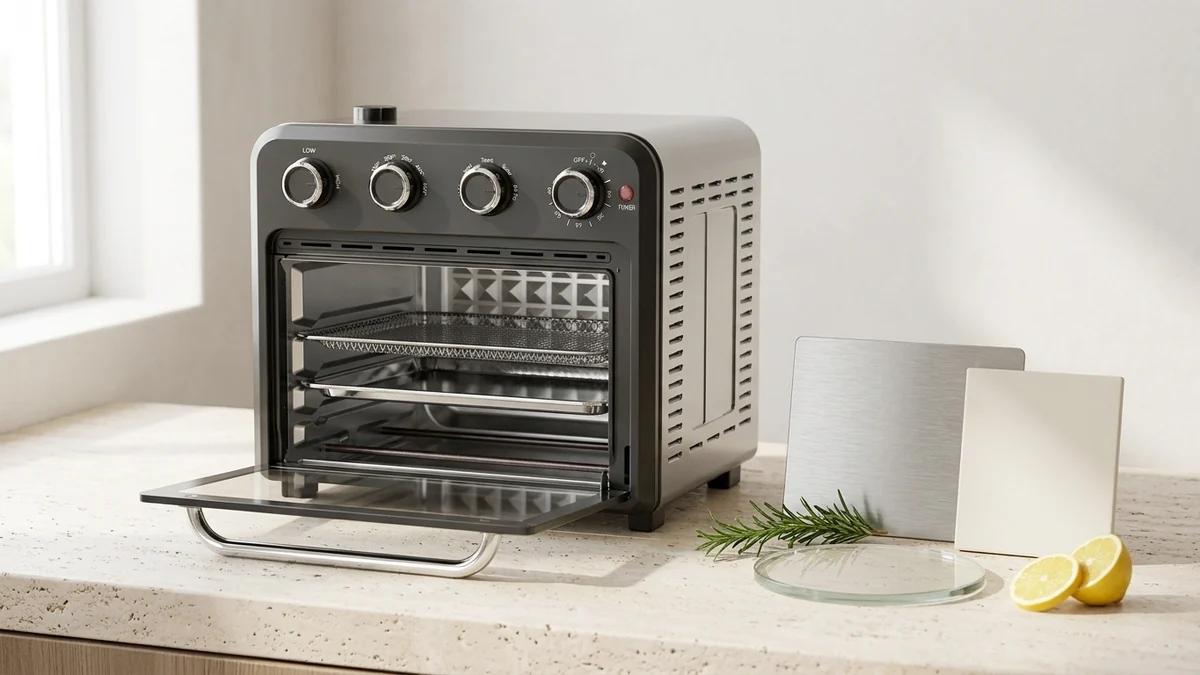
- Uncoated SUS304 stainless steel cavities, wire racks, and tempered glass doors provide a naturally PFAS-free cooking path preferred by EU and US retailers.
- Verify food-contact compliance by market: FDA 21 CFR & CA Prop 65 for the US; Regulation (EC) 1935/2004 and LFGB for Europe and Germany.
- Request part-by-part material declarations covering every surface that touches food or steam — including trays, baskets, and door gaskets.
Why "PFAS-Free" Became a Buying Question, Not a Marketing Slogan
Two years ago, food-contact material was a line in the specification sheet. Today it is a listing decision.
Consumer concern about non-stick coatings has pushed glass-basket models into the mainstream: CHOICE reports glass-basket air fryers are growing in Australian kitchens precisely because they swap coated baskets for glass — described as "naturally non-stick, PFAS-free" — while noting two caveats buyers must not ignore: the crisper plate may still be coated, and the glass itself measured over 100°C in use, a burn risk that has to be managed in design and in the manual (CHOICE, 2026).
Retail proof that the trend sells: the Ninja Crispi, built around a borosilicate glass container and listed as PFAS/PTFE-free, sells at $159.99 for the 4 Qt version and $299.99 for the Crispi Pro (list prices checked Oct–Nov 2026). At the 140th Canton Fair (Oct 15–19, 2026), SOKANY exhibited a 6L, 1,500W borosilicate-glass fryer positioned as "non-toxic, PFAS-free" (SOKANY press release, 6 Nov 2026).
At The Inspired Home Show 2026, Lotus led its premium line with a "PFAS-free nonstick interior" oven at an $899.95 SRP (HomePage News, 12 Mar 2026). For a private-label buyer, the question is no longer whether to offer a PFAS-free story — it is whether the story is true, part by part, and provable.
For reference, our own KA1203 from Foshan Linden Intelligent Appliances Co., Ltd. (Linden) is documented exactly this way: every food-contact part — basket, crisper plate and cavity — carries its material and coating specification in the project's per-part material list, which we supply together with the test reports behind it. That list, not a marketing label, is how every model should be documented, ours included.
The Four Material Options, Compared Honestly
| Material | Where it is used | Strengths | Trade-offs buyers must price in |
|---|---|---|---|
| PTFE non-stick coating | Baskets, crisper plates, cavity | Lowest cost, best release, proven at scale | Contains PFAS chemistry; Prop 65 and retailer reporting exposure; coating wear drives complaints |
| Ceramic (sol-gel) coating | Baskets, plates, cavity | Marketed as PFAS-free; good release when new | Release performance degrades faster than PTFE; durability claims need abrasion-cycle evidence |
| Stainless steel (uncoated) | Cavity, racks, some baskets | No coating to wear; strong food-contact dossier | Food sticks more; higher material cost; surface finish quality varies |
| Borosilicate glass | Basket/container formats | No coating on the container; consumers can see cooking; strong retail story | Breakage risk in transit and use; hot-surface (>100°C, CHOICE 2026) handling; heavier freight and packaging cost |
No option is free. A serious factory will walk you through this table against your channel and price point, instead of selling you whichever material it happens to stock.
Linden offers the KA1203 in alternative food-contact material configurations: the per-part material list for the version you choose is fixed in the written specification, the price difference between versions is confirmed by quotation, and the MOQ is 500–1,000 units per model per version. A borosilicate-glass version is in development and is not yet on offer.
The Crisper-Plate Trap in "Glass" Models
This is the single most common honesty failure in the current market. A model can have a genuinely glass container — and a coated crisper plate sitting inside it, plus coated accessories. CHOICE flagged exactly this: in glass models, "crisper plates may still be coated".
So the buyer's question must be asked part by part: basket or container, crisper plate, baking tray, rotisserie parts, and the cavity itself. If any one of them is PTFE-coated, the product is not "PFAS-free" — it is "glass basket with coated plate", and it must be described that way to your retailer and on your listing. Retailers increasingly audit claim wording, and a claim that collapses under one question from a retailer's compliance team costs far more than it earns.
Test Reports That Prove a Claim: FDA vs LFGB
"PFAS-free" and "food-safe" are claims, and claims need documents:
United States: food-contact materials are assessed against FDA 21 CFR requirements; your factory should hold migration/compliance test reports for the actual coating or material system used on your model.
European Union: the framework is Regulation (EC) 1935/2004, and German buyers in particular ask for LFGB §§30/31 testing; French buyers may additionally ask about DGCCRF food-contact compliance. Note: in our research we could not retrieve an oven-specific DGCCRF primary page, so confirm current French requirements with your test lab before printing claims.
The report must name the material and supplier. A generic "food grade" declaration covering a different coating from a different supplier proves nothing about your production units.
Ask for the report number and verify it with the issuing lab — the same discipline you apply to safety certificates.
For the KA1203, the food-contact reports for your version — FDA 21 CFR for the US route and LFGB §§30/31 for the EU route — are commissioned for the actual material system used in production and are shared with the project documentation, so you can verify each report with the issuing laboratory. For California Prop 65, the KA12 series is covered by Bureau Veritas test report No. (8525)105-0462 (24 Apr 2025), which returned a PASS for total lead, total phthalates and total cadmium.
Prop 65 and Retailer PFAS Reporting
Two US compliance layers catch buyers out. First, California Proposition 65: if a listed chemical is present above threshold levels, a warning decision has to be made deliberately — documented, not improvised at the labeling stage. Second, retailer protocols: Walmart's production-testing program includes Washington-state PFAS reporting and Prop 65 checks as part of vendor compliance (Lifeworks Supplier Portal summary of Walmart production testing, 2026).
In other words, your retail customer may be required to report PFAS content whether or not your marketing makes any claim. The safe position is full material disclosure from the factory, per part, before the listing is approved.
Glass Trade-Offs: Breakage, Burns and Packaging Cost
Glass is a strong story with real engineering costs:
Breakage: glass containers need upgraded packaging — foam protection and drop performance — which affects carton size, container loading and FBA economics. Validate with drop/ISTA testing on the final retail pack, not the bare product.
Burn risk: with glass surfaces measured over 100°C in use (CHOICE, 2026), handle design, warnings and manual language are part of the product, not afterthoughts.
Weight: heavier units raise freight per unit and can push cartons toward carrier weight limits.
None of this argues against glass — the retail prices above argue for it. It argues for costing glass honestly, as a system.
Our glass-container development work uses an existing oven platform as its base. Glass thickness, packaged drop performance, unit gross weight and container loading for a glass version are all set at project specification — because the upgraded packaging a glass container needs changes every one of those numbers — and we will not quote catalog figures for a version that is still in development.
Claim Wording That Survives Retailer Review
Say "PFAS-free food-contact surfaces" only when every food-contact part qualifies — and keep the per-part material list on file.
Say "PTFE-free ceramic coating" for ceramic systems, and state the coating brand/system so the claim is checkable.
Say "borosilicate glass container" when the container is glass but accessories are not — and disclose accessory materials in the specification.
Never copy a competitor's claim wording (e.g. a trademarked program name) onto your listing; claim language is also an IP and advertising-law question in the US and EU.
Buyer Checklist: Material Questions for Your RFQ
List every food-contact part and its material/coating — basket, plate, tray, cavity, accessories.
Which parts, if any, contain PTFE or other fluoropolymers?
FDA / LFGB report numbers for each material system, and can I verify them with the lab?
What is the coating abrasion-cycle rating, and what does the surface look like after it?
For glass: glass type, breakage rate in transit testing, packaging spec and carton weight?
What is your documented Prop 65 position for this exact model?
Build Your PFAS-Free Line — With the Documents to Back It
Send us your target channel and price point, and we will respond with the material options we can actually build for you, the per-part material list, and the test reports behind every claim — before you commit to tooling or a listing.
Contact Linden at [email protected] or +86 156 2237 7841.
Ready to Spec Your OEM/ODM Air Fryer Oven Line?
Get factory FOB pricing, test certificates, and 500–1,000 unit MOQ customization options within 24 hours.
Related Sourcing Guides

What the Cosori and Insignia Recalls Teach B2B Buyers: 7 Safety Questions to Ask Any Air Fryer Factory
Cosori — CPSC recall 23-130, 23 Feb 2023. Around 2 million air fryers were recalled in the United States, plus roughly 250,000 in Canada and 21,000 in...
120V vs 220–240V: Building US, EU, UK and AU Versions of the Same Air Fryer Oven
An air fryer oven is not one product with four plugs. It is one platform that has to be re-engineered, re-certified and re-documented for each electrical...